

Ad
Top Story
Ruling to affect school calendars
Published
Modified
BELEN — A recent court ruling striking down the New Mexico Public Education Department’s rule mandating at least 180 instructional days for public and charter schools may not have a huge impact on one local school district.
Last year, the New Mexico School Superintendents Association filed a lawsuit against PED, arguing the state agency overstepped its authority by mandating a minimum number of instructional days.
Belen Consolidated Schools Superintendent Lawrence Sanchez said the district signed onto the suit even though the Belen Board of Education wants a minimum of 180 days for the district.
Download PDF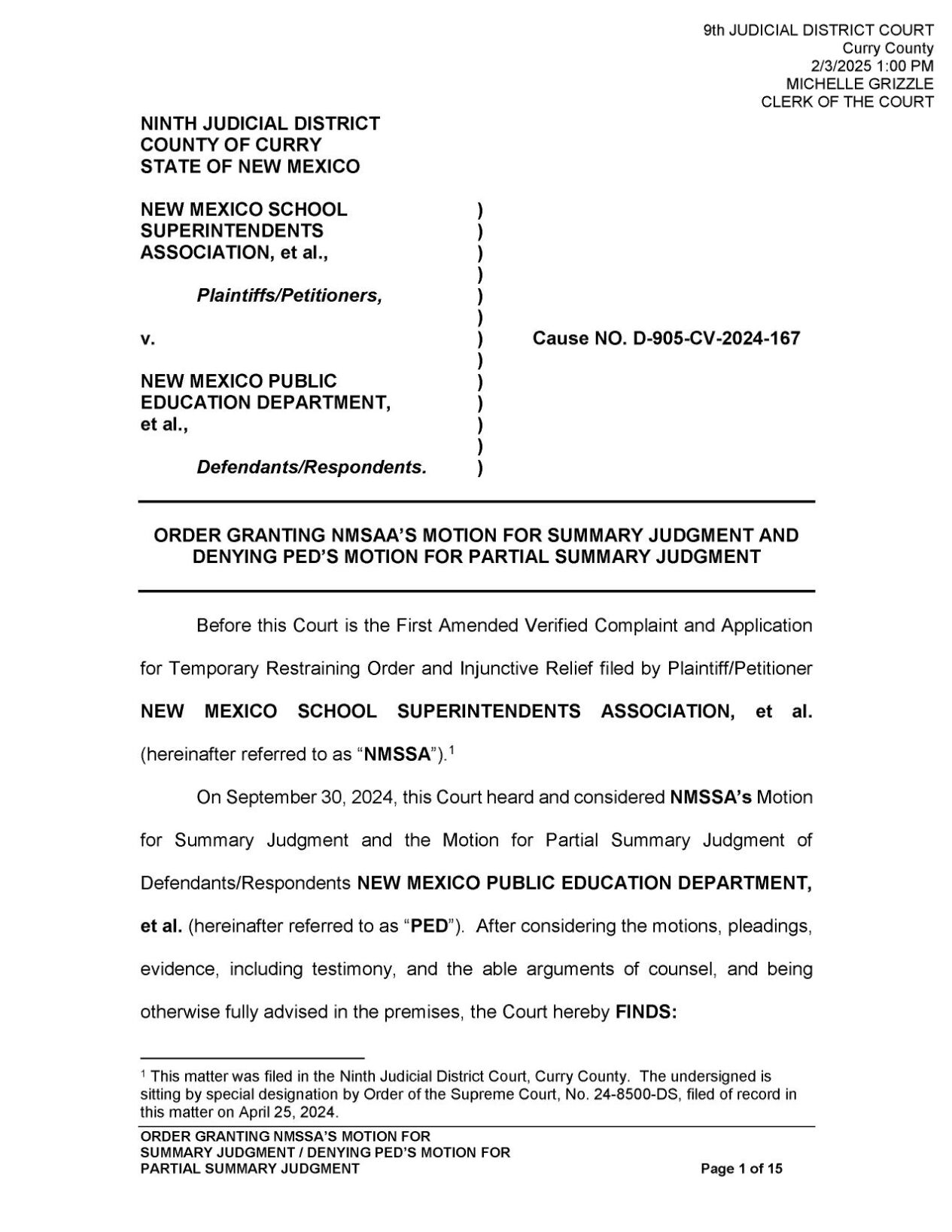
“We participated more on the belief that this needs to be a matter of local control. The board does want to see a 180-day minimum,” Sanchez said.
On Feb. 3, 9th Judicial District Court Judge Dustin Hunter granted NMSSA’s motion for summary judgment finding that, “The administrative action taken by the PED exceeded the discretion and authority otherwise afforded to it by implementing provisions ... which are inconsistent with the existing statutes and legislative purpose ...
“These actions, while undeniably being well intentioned and for the purpose of improving the education of certain New Mexico students, exceeded the PED’s authority and the rule is inconsistent with the intent of the Legislature.”
Sanchez said at this point it’s still unclear what, if anything, the ruling will mean for BCS.
“I don’t see a lot of changes as far as students are concerned,” the superintendent said. “Also, the state has 30 days to appeal. Even if they do appeal, that will take us past the time calendars are due. I would guess the judge’s order remains in place until any appeal is done.”
While the 180-day requirement being eliminated is getting most of the attention, Sanchez said there was a second component to the judge’s ruling that’s also key — the scheduling of professional learning hours for teachers during the school year.
Elementary teachers are required to have 60 hours of professional learning per year and secondary teachers are required to have 30 hours, however PED directed those hours not occur during instructional days.
Ad
“That led to a longer teacher calendar to get those days in. The judge ruled that wasn’t kosher,” he said. “What is PED going to do with that part? We could create a calendar and still not be in compliance with the rules in terms of those hours. That is still something to consider.”
The district is currently building out the 2025-26 school year calendar and has put out a survey asking for feedback. A link to that survey was posted on the BCS Facebook page on Monday, Feb. 10. It asks for preferences on when the school year should begin and end, as well as the length of Thanksgiving and Christmas breaks.
“We did some rough math and last year we had 225 days available to schedule 180 days. Do parents want more time off for Thanksgiving? Five days rather than three? How long do they want Christmas break to be? We have to give off for federal holidays. When we look at all of this, it’s not as wide open as people think,” Sanchez said. “We need to find out what is important to people.”
Additionally, PED is scrutinizing calendars statewide, making sure seniors attend classes all the way to the end of the scheduled year.
“PED is looking at when our seniors are graduating and if we don’t have them there until the end of the year, they are talking about pulling back the K-Plus funding, which for BCS is about $70,000,” Sanchez said. “If next year looks the same, we might push graduation out to the end of school. PED is really paying attention to what we’re doing and we’re dependent on that funding.”
The 2024-25 school year calendar for BCS shows the last day of classes as Friday, May 23, with graduation for Infinity High School on Thursday, May 15, and Belen High School graduation on Tuesday, May 20.
History of the rule
In Hunter’s order granting NMSAA’s motion for summary judgment, he wrote the case pertained to the validity of New Mexico Administrative Code 6.10.5, School Instructional Time Requirements, aka the “rule.”
He cited the 2018 Martinez/Yazzie litigation, a case in which a district court judge ruled that while all New Mexico students have a right to be college and career ready, the state was failing to meet that obligation. In it’s defense against the NMSAA complaint, PED argued the rule was part of its ongoing attempt to improve education in the state in accordance with the Martinez/Yazzie ruling.
“The court does not doubt the PED or the secretary’s good intentions with regard to the rule,” Hunter wrote noting “intent of the implementation of the rule was to help students become college and career ready.”
Rather, the question raised by the association was whether PED exceeded its rule-making authority and whether the rule conflicted with the section of the New Mexico Public School Code that governs the required length of school calendars.
Prior to 2009, the public school code required students to be in school for a minimum number of hours but there was no minimum day requirement.
In 2009, the code was amended to require 180 instructional days for a regular school calendar and 150 days for a variable school year calendar. That same year, the public school code was also amended to mandate a school district’s budget wouldn’t be approved by PED unless it met those minimum days. The NMAC rule was changed in 2009 as well to include the 180-day requirement.
Those changes were due to go into effect for the 2010-11 school year, but the Legislature delayed implementation until the 2011-12 school year. According to Hunter’s decision, the Legislative Education Study Committee reported several problems with the 180-day requirement, including that it would cause an increase in many per-day operational costs for certain districts and charter schools.
In 2011, the LESC study group estimated if all districts added one additional instructional day, the additional cost would have been about $13 million per day in 2011 dollars.
The Legislature amended the public school code in 2011, repealing the 180-day requirement and reinstated the language requiring a certain number of instructional hours for school calendars.
In 2023, the state Legislature passed House Bill 130, which took effect July 1, 2023, that increased instructional hours per year for all grade levels to 1,140 from the previous 1,080 for secondary students and 990 for elementary students. The bill contained no language mandating a minimum number of days.
In late March 2024, PED adopted the new rule which required schools to adhere to both the minimum number of instructional hours and a 180-day instructional calendar, unless they met certain proficiency and growth targets in reading, language arts as determined by the (PED) secretary. The new rule was set to begin in the 2024-25 school year.


