

Ad
Building Businesses in Valencia County
Focusing on the future in Valencia County

Published
Modified
While some local municipalities seem to be adding new businesses and houses on a daily basis, growth and development in the unincorporated communities of Valencia County could best be described as slow but steady.
The unincorporated areas — those outside the limits of the five municipalities — are geographically diverse, leading to a variety of priorities which can sometimes be in conflict with each other.
Valencia County land use planner Ryan Baca said while there is more interest in commercial on the county’s east side, in the communities of Meadow Lake and El Cerro Mission, communities in the southern part of the county, such as Pueblitos and Jarales, are much more focused on traditional agricultural pursuits.
When the county’s most recent comprehensive plan was approved in 2022, community feedback quickly identified that tension. Of the 450 people who responded, about 70 percent identified the county’s rural character and small-town feel as what they like most, but more than 60 percent wanted to see growth in services, such as retail shopping, small businesses and restaurants.
It falls to Baca and Valencia County Community Development Director Melissa Jaramillo to balance those two divergent priorities as they handle the day-to-day business of zone change requests, subdivisions, permits and variances. Unlike some local municipalities, the county doesn’t have a position dedicated to economic development and enticing businesses to the unincorporated areas.
“I would like to see us have that approach. Victoria Archuleta (senior economic developer for the village of Los Lunas) has been instrumental in trying to bring us into that,” said Jaramillo. “Right now, if someone were to come in with a (development) idea, we would be able to sit down and review it, direct them to the comprehensive plan. Let them know what they can and cannot do, what’s permissible. We’re more of the facilitators.”

In an effort to guide development in the county, the comprehensive plan sets out existing and future priority growth areas, which can give county administrators and the county commission a way to manage growth and balance the needs for additional housing and retail with the desire to keep the agricultural character of the county.
The comprehensive plan identified existing priority growth areas of El Cerro Mission Road and Manzano Expressway and the area in the vicinity of the Rio Grande Industrial Park on N.M. 304, south of the city of Rio Communities and the BNSF rail corridor.
Future priority growth areas include the Rio Del Oro Loop and Manzano Expressway area near Las Maravillas and the village of Los Lunas’s west mesa area, south of N.M. 6 and west of Interstate 25.
Priority growth corridors identified in the plan include the north Manzano Expressway corridor from El Cerro Mission Boulevard to Meadow Lake Road, Meadow Lake Road east of Los Lunas, and the Morris Road corridor between I-25 and N.M. 47.
Ad
“We’re starting to see more growth being directed towards our priority growth corridors and areas,” Baca said.
In December 2021, a zone change from Rural Residential 1 to Commercial 1 was approved at 496 Meadow Lake Road to allow for a restaurant on the property, as well as a conditional use permit for an RV park.
West of the village of Los Lunas on N.M. 6, 150 acres was rezoned from outland district to light/general industrial (I-2) in the spring of 2023, and earlier this year, 4.5 acres on the southwest corner of Meadow Lake Road and Cypress Boulevard was rezoned from Suburban Residential to Commercial 2.
Zone change requests are mostly for mom-and-pop businesses, rather than large developments, Baca said, but there has been an increase of requests along those growth corridors.
Businesses, as a whole, have been increasing in the county in the last few years, with 103 in 2020 increasing to 147 in 2023. To date this year, there are 121 registered businesses. The primary categories for those businesses include food trucks/restaurants, construction trades, such as electrical, roofing and plumbing, transportation and auto repair/sales.
Baca said the county is seeing some new housing — both small developments and single home projects — being built, as well as an up-tick in auxiliary and accessory structures.
“We are also getting a lot of people wanting to do different types of workshops and accessory structures for hobbies. Craft rooms, wood working, collectible cars,” he said.

Lot splits to divide property among family members is also another common land use application the county receives, Jaramillo said.
“What I’ve seen more is people wanting to break up their property for their children. Their children are growing up, getting married, having babies and everybody wants to be around each other,” she said. “I also would say a lot of these changes are trying to find affordable housing options. Smaller parcel sizes are making them more affordable. That’s kind of been a bit of a trend lately.”
Download PDF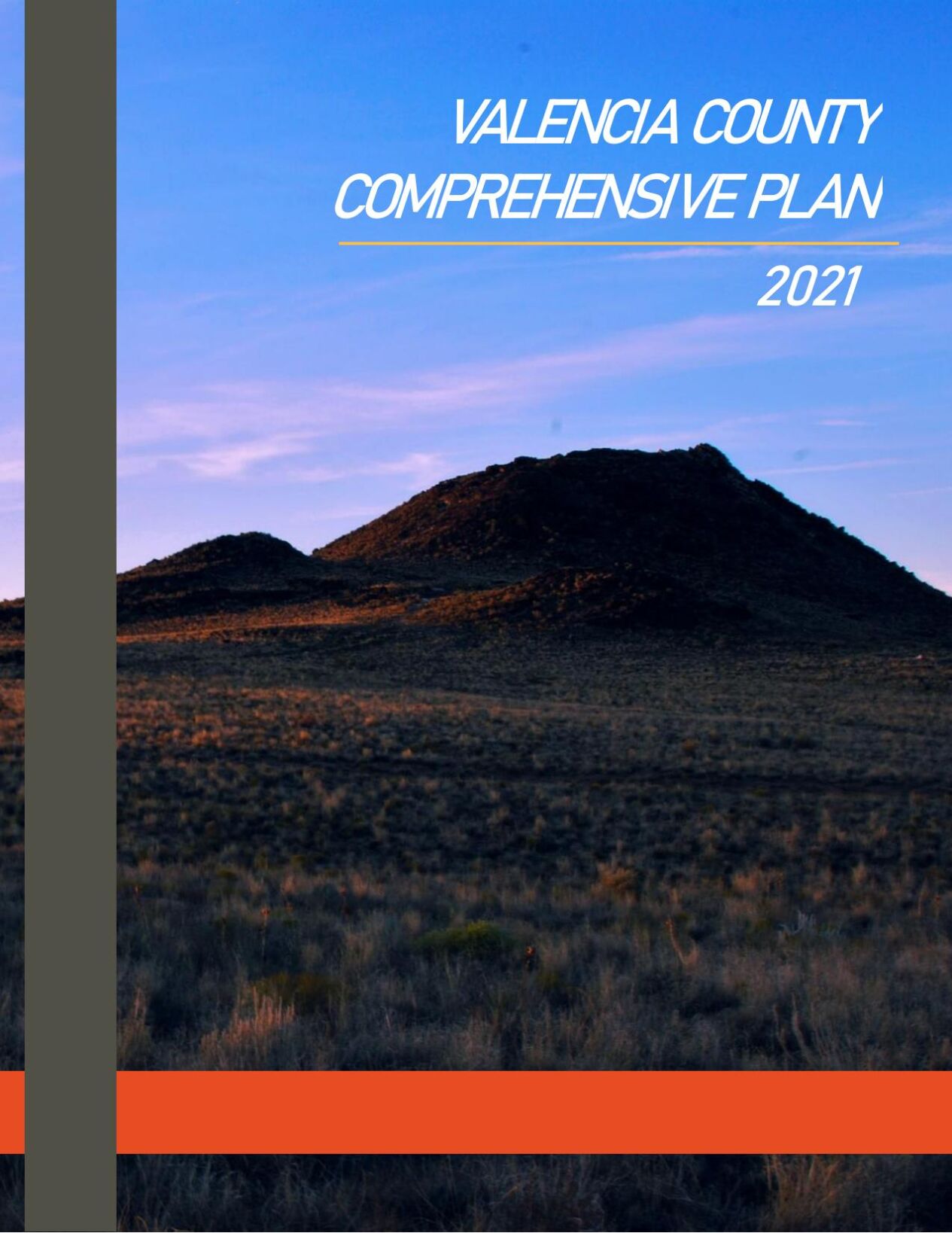
Through the valley and into the southern part of the county, agriculture continues to be a way of life, Baca said, which is still commercial in its own sense, he noted.
“It’s not a store-front business, but it is still a business. We have a significant amount of farmers, specifically chile farmers, and a lot of agricultural hay sales,” he said. “We aren’t directly involved in that because a lot of it is just an allowed use (of the land). A big part of the county’s comprehensive plan wanted to maintain those agricultural activities.”
According to the 2022 Census of Agriculture compiled by the USDA National Agricultural Statistics Service, there were 978 farms in Valencia County that year totaling 450,426 acres. The majority of those farms — 873 — were less than 10 acres and 18 were 1,000 acres or more.
While she wasn’t with the county when the comprehensive plan was last overhauled, Jaramillo said she did review the responses from the community survey and in regards to the rural nature of the community, “they just didn’t want that to change. It’s a big part of the community identity and you have to honor that. So, we are pushing things towards those priority growth areas and corridors to allow for access to goods and services.”
She encouraged anyone wanting to establish a business or develop in Valencia County begin that process by reviewing the comprehensive plan.
“There’s a lot that has already been studied that can be found in the plan,” Jaramillo said. “We are trying to utilize it as much as we can. We want to try to stick to those priority growth areas so we can preserve our rural areas.
“We are hoping in the future we can start focusing a lot more specifically on economic development and providing incentives for more businesses.”


