

Ad
Legislation would increase 911 fee; modernize system

Published
Modified
An update to legislation pertaining to 911 services is getting the support of the district director for the Valencia Regional Emergency Communications Center.
VRECC district director Tommy Sanchez says not only will updates contained in Senate Bill 137 bring the language into the modern era but will increase a critical funding mechanism for dispatch centers.
“Everybody deserves the right to be able to reach 911, right? This legislation would not only modernize the existing act and make it relevant with today’s standards, it would increase the 911 surcharge which hasn’t changed since 1989,” Sanchez said.
Download PDF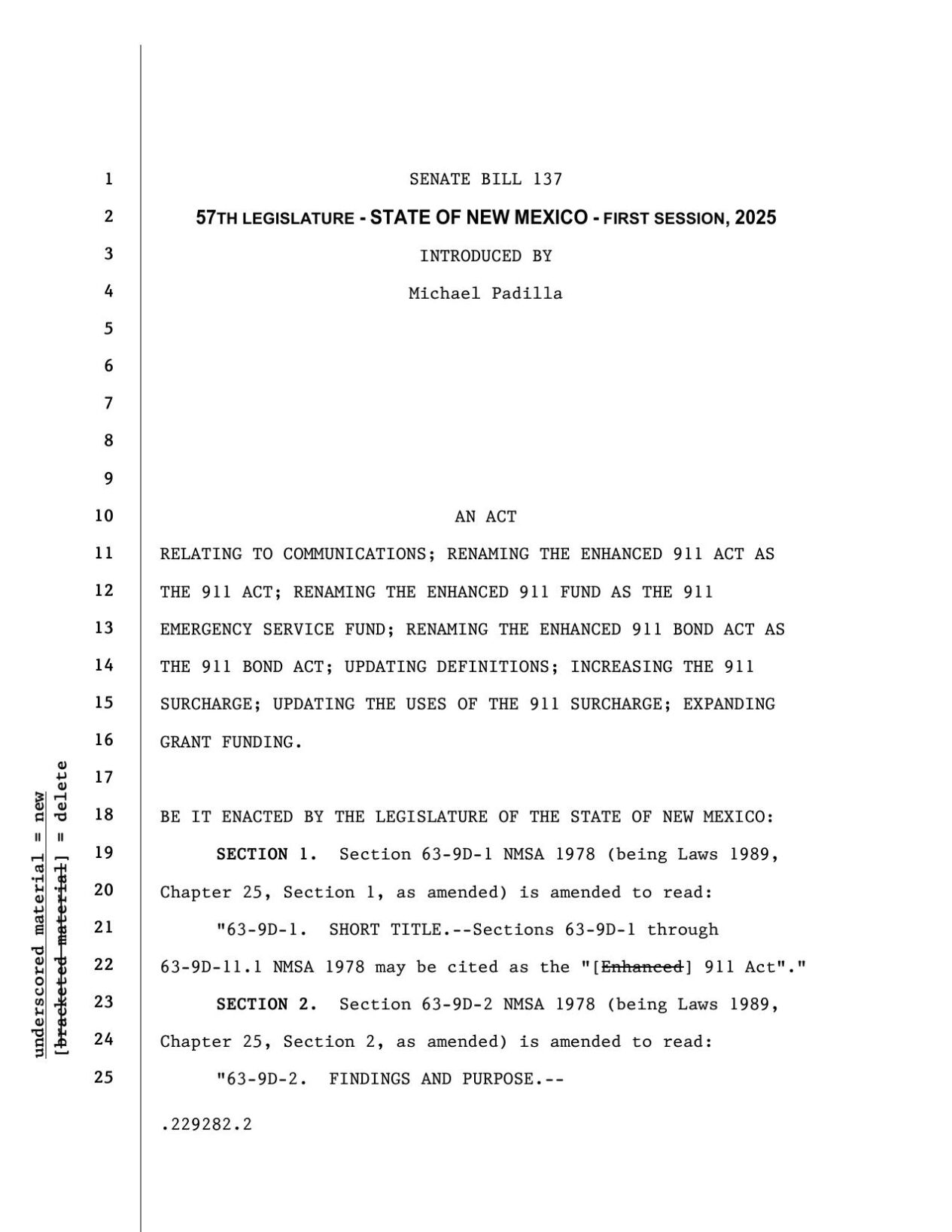
Currently, there is a 51 cent monthly surcharge imposed on all landlines, cell phone and voice-over-internet-protocol lines to support dispatch centers. SB 137 proposes increasing that surcharge by 99 cents for a total of $1.50 per line per month.
“It’s just frustrating to me that this didn’t even have a mechanism to keep up with inflation,” Sanchez said. “We need some kind of mechanism to make sure it adequately accommodates the times because otherwise you get stuck with things that become antiquated. A lot has changed since 1989.”
New Mexico implemented its Enhanced 911 Act that year and not much has changed since, the director says. The proposed legislation renames the act to simply the 911 Act and updates language to include next-generation capabilities such as voice, text, video and data processing, as well as increases the 911 surcharge.
The surcharge won’t be applied to the bills of customers receiving reduced rates under the Low Income Telephone Service Assistance Act — better known as the Lifeline program, which was established in 1985 to provide a discount on phone service for qualifying, low-income people — and does not apply to prepaid wireless communication services.
Having a dispatch center with equipment and software that is next-generation capable — and dispatchers who are trained to use those systems — improves accessibility and emergency response accuracy, Sanchez said.
“This is a significant step forward in improving our emergency response infrastructure and ensuring the safety and well-being of our community,” he said.
Next-generation technology for dispatching can bring improvements, such as immediate visual display of the location and telephone number of the caller, improved accuracy and efficiency in emergency response due to advanced geographic system capabilities and internet-protocol-based technologies and greater system redundancy to ensure continuous operations during emergencies.
Ad
“It modernizes our systems to make sure we can get to people quickly. That’s the biggest part of all this,” Sanchez said.
In 2024, VRECC handled 116,924 calls for services with a call volume of 161,759, Sanchez said, noting New Mexico has one of the highest 911 volume per capita with one of the lowest surcharges in the country.
In 2023, according to the 16th annual fee report filed with the Federal Communications Commission, 3,997,337 911 calls were made in New Mexico. For the same time period, Nevada’s 911 services received 1,986,810 calls and Wyoming received 224,216.
Wyoming collects 75 cents per line, while Nevada charges $1 per line with an additional $10 monthly fee charged at the county level.
In the current fiscal year of 2024-25, VRECC received $710,991 from the 911 surcharges collected by the state. That funding cannot be used for staff salaries. Sanchez said that amount varies from year to year based on the center’s needs.
VRECC also receives funding from the local municipalities, Valencia County and AMR ambulance service based on the number of calls for services.
“The biggest thing that bothers me is I’m here to support all my agencies in Valencia County, but when we get into the funding, it almost feels like when I’m approaching them, I’m hurting my own agencies to fund my center,” Sanchez said. “Whether it comes from the surcharge or the agencies, it’s still taxpayer dollars. The call volume is still going to keep increasing and the need for funding is still going to be there.
“I should be able to adequately support my own center without feeling like I’m hurting other responders. 911 needs to be here. It needs to be staffed. It needs to be modernized.
“We have a lot of dedicated people who are unseen behind these walls that do a lot to support their community. I feel like they’re genuinely overlooked.”


