

Ad
Designing a new Dennis Chavez Elementary
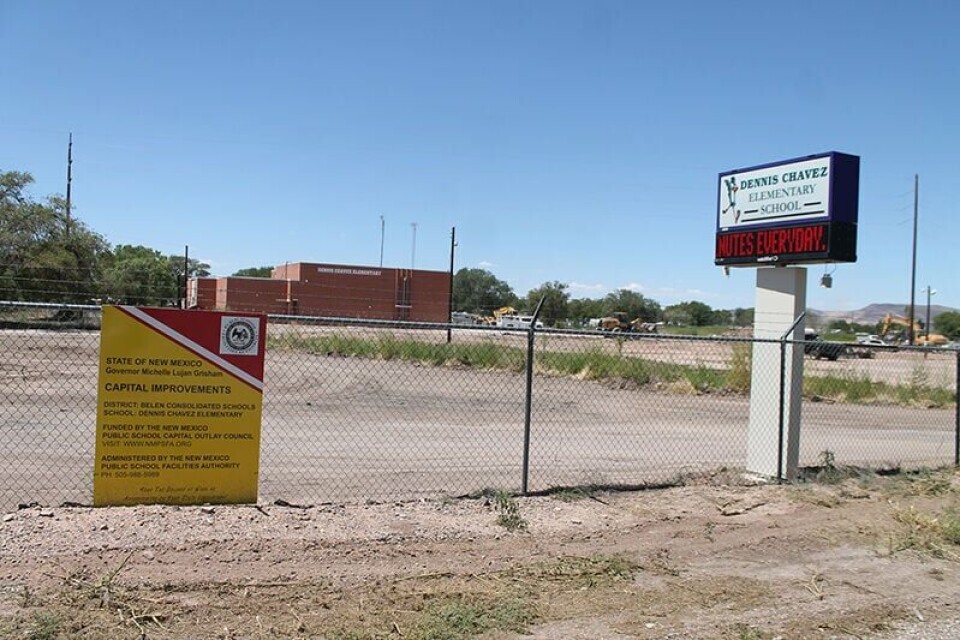
With the demolition of the old Dennis Chavez Elementary complete, the district is working to finalize the design of the new campus.
Published
Modified
BELEN — As design work for the new Dennis Chavez Elementary wraps up, the Belen Board of Education is giving careful consideration of how to balance safety features it deems necessary against what the state will pay for under defined adequacy standards for schools.
That discussion started at the Oct. 22 BOE meeting with a change order for $108,638 for design changes to the new campus that includes a new well, holding tank for the fire suppression system and a pre-kindergarten classroom. The board approved the request 4-0.
The next agenda item — basically a head’s up on a future change order — gave the board pause as they discussed keeping a handle on change orders and prioritizing safety needs.
The item was from the construction committee for DCE for approval to add sinks with bubblers and cabinetry to the first through third grade classrooms and the music room. While the costs of the approved change order for design changes will be split between the district and the state, the cost for sinks and bubblers would be 100 percent on the district.
Board member Aubrey Tucker asked if the district could afford the request, to which BCS Superintendent Lawrence Sanchez said “yes,” but with caveats.
“It’s a question of what are we not going to spend money on. Can I tell you exactly what that is? No,” Sanchez said.
When a new school is built, safety standards have to be met by the district, not the state, noted board president Jim Danner.
“As we look at this, are we going to have to take something from safety to take care of this? Was this part of the initial recommendation from the teachers?” Danner asked.
Sanchez said it was, but wasn’t included in the design because it wasn’t part of the state’s adequacy standards. According to state regulations, the adequacy standards are “intended for use in the evaluation of baseline requirements for existing public school facilities and are not intended to limit the flexibility of design solutions for new construction and renovation projects.”
However, BCS and other districts find themselves in the position of having to adhere to the adequacy standards on new builds — the cost of which is split between the district and state — in order to receive that financial support. Any design elements outside of the standards are paid for solely by the district.
Ad
Danner said he was willing to support the request, since it came from the teachers originally, but was “leery what will occur after. I want to remind my fellow board members, with change orders we have to be very diligent.”
Tucker was critical of the New Mexico Public School Facilities Authority.
“Shame on the PSFA and any other entity that does not fund all safety standards required by a safety plan ... The way the world is, I don’t want to skimp on safety. If we have to have some dirty hands to stop a bullet from going into a classroom, kids can have some dirty hands. I will support this but I’m upset to be put in that position.”
Board member Joanne Silva noted the adequacy standards don’t match safety standards. Sanchez agreed with her statement, saying the district was “not cutting from student safety to pay for sinks.”
The board voted 4-0 to approve the construction committee’s request to add the sinks, bubblers and cabinetry to the design. Sanchez said the change order would come to the board in the future and would probably be less than $200,000. Board vice president Ralph Fernandez wasn’t at the meeting.
In an interview following the meeting, Sanchez said the frustrations he and the board voiced are shared by districts across the state.
“Not to sound overly critical, but we know with bureaucracies it takes time to implement change. Everyone agrees something needs to be done. It takes time,” the superintendent said.
The adequacy standards determine a variety of aspects of a school, such as the size of a classroom depending on the grade.
“There’s this whole set of adequacy standards when the school is being designed that the architects are aware of so we can try to avoid changes. And then we have a third partner in this — PSFA — and they look at (the design) and say ‘yes, this falls under adequacy,’ or ‘no, this doesn’t.’
The adequacy question is directly tied to what the cost of a project will be for an individual school district. In the case of the DCE rebuild, the district is responsible for 48 percent of the cost of the project that the state determines meets adequacy standards. The state will cover the remaining 52 percent.
That split was grandfathered in since the project funding was approved several years ago; new construction projects are now split 78 percent from the district and 22 from the state, although state legislation has been enacted to drop the district share by 33 percent. A district’s percentage is determined by the property valuations within its boundaries.
The project was initially estimated to be about $35 million, but Sanchez said with risking construct costs, it will probably be higher.
Regardless of the split, there are still items that fall outside of adequacy which the district has to pay for if it wants them.
“Talking about security specifically. When you look at a control axis,” Sanchez said, holding up his electronic key card for secure doors. “Under adequacy standards, the state pays for (it’s part of two doors). If we want more, then that’s 100 percent on us. I don’t know of any school with only two access points.”
Other security features, such as cameras, are also not part of the state’s adequacy standards, he said. While PSFA will pay for its percentage of the conduit needed to run networking cables for a security camera network, the district is on the hook for 100 percent of the cost for the actual networking cables, cameras and any maintenance that goes with such a system.
During a recent meeting of superintendents from across the state with newly-appointed secretary of the New Mexico Public Education Department Mariana Padilla, Sanchez and others expressed their frustration over the misalignment between adequacy standards and safety needs.
“We sat for more than an hour listening to a presentation from state police about school safety and what they are trying to do to support schools. And I appreciate all that, but I told her until we change the adequacy standards and say safety measures are required in the building of our schools, you’re not putting your money where your mouth is,” he said.
Sanchez said it is his understanding that PSFA has been gathering data on what schools need on the ground.
“Now they’re looking at it and it’s not a simple thing. They want to make it as close to right as they can but nothing’s ever 100 percent right,” the superintendent said.


